
This past month it felt a lot like somebody had pulled the string at the back of the bond market, as yields headed for the sky.
“Reach for the sky!”
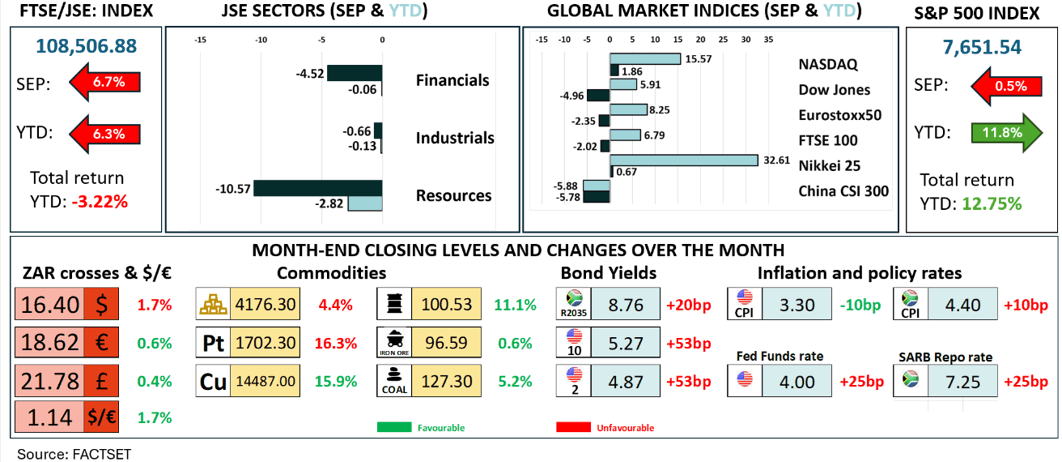
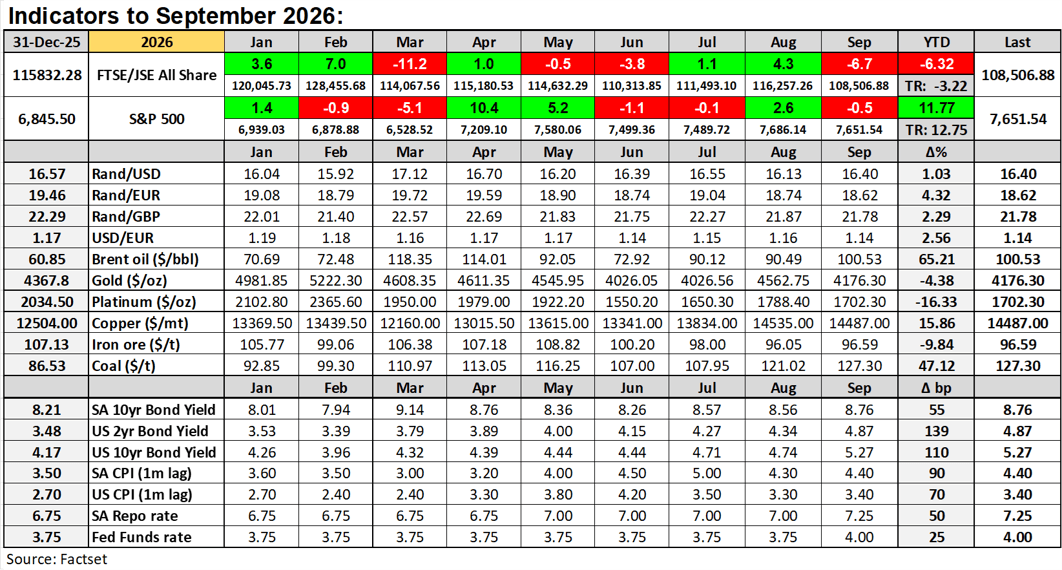
Toy Story fans will remember Sheriff Woody’s famous pull-string voice box line “Reach for the sky” when the string in his back was pulled and released. This past month it felt a lot like somebody had pulled the string at the back of the bond market, as yields headed for the sky. In the US, two-year Treasury yields hit their highest level in two years, five-year yields rose above 5% for first time since 2007, and 10- and 30-year yields rose to their highest levels since 2002, hitting 5.30% and 5.65%, respectively, on the very last day of the month. The yield on the South African 10-year bond, proxied by the R2035, rose by 20 basis points to close out September at 8.76%.
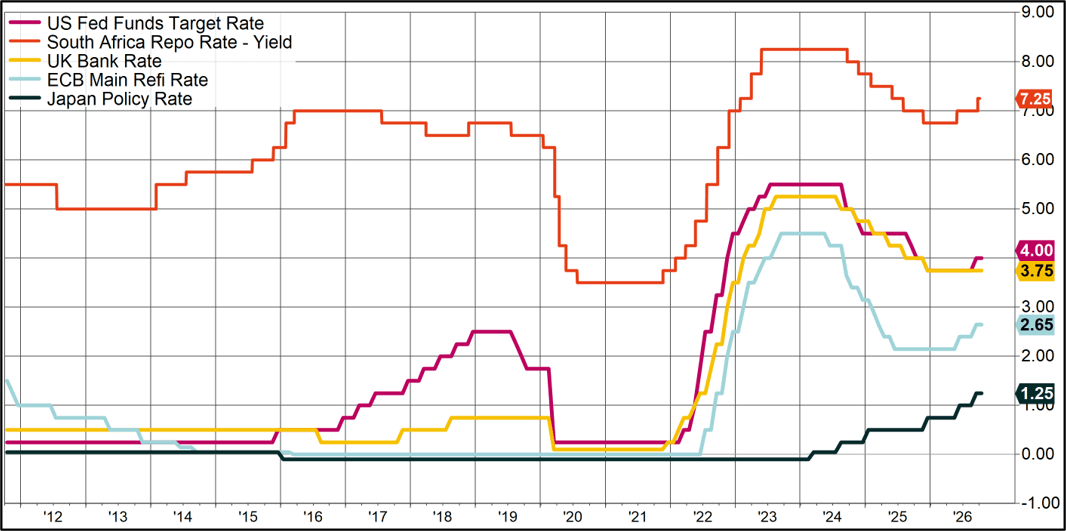
The back-up in US bond yields came from various quarters with inflationary pressures providing the impetus earlier in the month. As the US-Iran conflict entered its seventh month, with no end in sight, oil prices rose above $100/barrel, adding pressure to producer prices and raising the prospect of further increases in consumer prices. US diesel prices climbed to their highest level in history, closing out the month at $6.53/gallon from $3.54/gallon at the start of the year. Bond yields were also spooked by concerns for the fiscus after President Trump promised a $5,000 payout to all US adults should the Republicans retain control of both the Senate and the House of Representatives at the November mid-term elections The Federal Reserve Bank’s first interest rate hike of the cycle (see chart below) helped prod bond yields higher but the bigger push came from comments from Fed chair Warsh, who insisted that the rate hike was about “removing a dose of accommodation” rather than making them less restrictive – this was taken as a sign that rates could potentially go higher than anticipated if the target of the Fed Funds rate was truly seen by Warsh as still being accommodative. The bond-buying programme in the long end of the yield curve by US Treasury Secretary Scott Bessent did nothing to restrain bond yields and his “I am the house” bravado probably only irked market participants. The bond issuance and the demand for credit from the hyperscalers to invest in capital and infrastructure continued in September and merely added fuel to the bond fire.
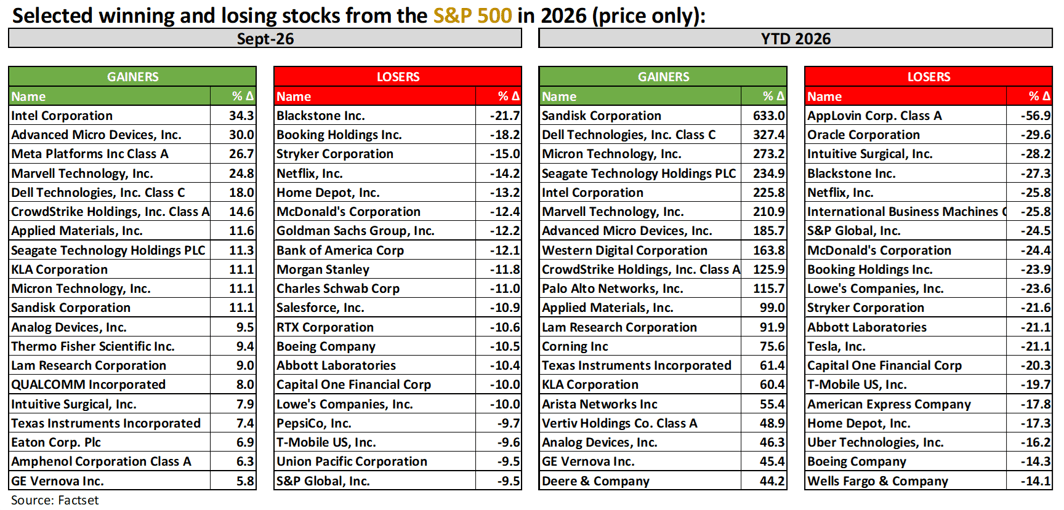
On the equity front, the S&P 500 index lost 0.5% in September but this return masked the wide variation in the underlying market sectors. Technology stocks ruled the roost and the Technology sector gained 4.4% in the month to follow its 6.2% gain in August. Meta had a meteoric rise of 26.7% on the back of its release of Muse AI and that helped lift the Communication Services sector by 4.3%. All of the other sectors declined in September and underperformed the S&P 500: Healthcare (-1.0%), Energy (-2.8%), Consumer Staples (-3.5%), Industrials (-4.5%), Consumer Discretionary (-5.9%), Utilities (-6.1%), Real Estate (-6.7%), Materials (-6.9%) and Financials (-7.3%).
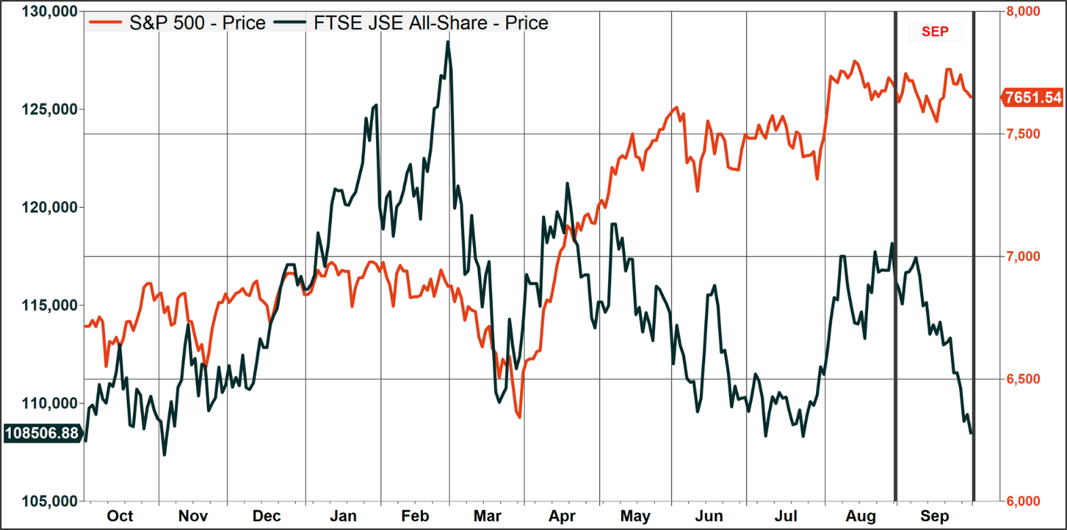
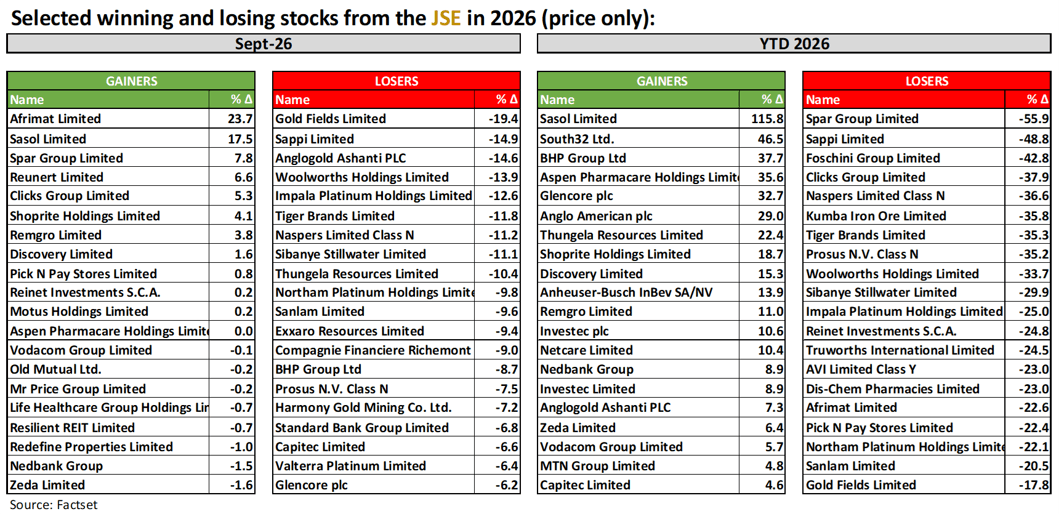
The FTSE/JSE All Share index lost 6.7% in September, its second-worst month of the year, with all three market sectors declining in the month. With the JSE only fractionally in the green at the end of August, the September decline left the market down 6.3% for the year to date (see the graph below). The Industrials sector lost 0.7% and the Financials Sector lost 4.5% but the real damage was done by the 10.6% decline in the Resources sector. Resources stocks comprised almost 35% of the market at the start of the month with Gold Fields (7.7% weight), AngloGold Ashanti (6.8%), Valterra Platinum (4.0%), Anglo American (2.9%) Implats (2.1%) and Harmony (2.0%) making up just over 25% of the index. The 4.4% decline in the gold price over the month pushed the market’s two biggest heavyweights, Gold Fields (-19.4%) and AngloGold Ashanti (-14.6%), substantially lower while the 16.3% decline in the platinum price was reflected in the 12.6% decline in the price of Implats and the 6.4% decline in the price of Valterra Platinum. Tencent, which started the year at HK$599 continued its slide over the month, slipping from HK$453 to HK$431 and driving Naspers down another 11.2% and Prosus down 7.5%. These two counters are amongst the worst performers this year but they find themselves in the company of the food retailers (Spar -56%, Pick n Pay -22%), clothing retailers (Foschini -43%, Truworths -25%), pharmacies (Clicks -38%, Dischem -23%) and food producers (Tiger brands -35%, AVI -23%). These mostly South African economy-facing companies have struggled in an environment of weak demand and low confidence. As the South African Reserved Bank tightened policy for the second time in the cycle in September, the governor provided a downgrades 1.2% forecast for economic growth for this year (from 1.4% at the July meeting).
One stock that did buck the market trend was small cap, non-energy, materials stock Afrimat. The R5bn market capitalisation stock gained almost 24% in September but this bounce was after touching a 52-week low in August after the company advised the market of the toughest conditions facing the company in its 20-year history. Some slightly better construction sector news in the month and a bit of opportunistic buying contributed to the substantial gain which still left the stock down 22.6% for the year to date. Sharply higher energy prices also played into the hands of Sasol which gained 17.5% in the month and closed out September almost 116% higher for the year so far - see the list of gainers and losers in the appendix below.
FTSE/JSE All Share index (black, LHS) and S&P 500 (vermillion, RHS): One year (daily)
Source: FACTSET
Can a strong US results season see markets rally into year-end?
The US Q3 earnings reporting season unofficially kicks off on the 13th of October when some of the US’ largest financial companies publish their corporate results. JP Morgan Chase & Co, Wells Fargo & Co, the Goldman Sachs group and Citigroup all release Q3 numbers before the market opens on that day. Healthcare giants UnitedHealth Group and Johnson & Johnson will also release results on the 13th before the opening bell. Blackrock, Bank of America and Morgan Stanley report the next day, along with Dutch-listed semiconductor equipment manufacturer ASML. The latter is not included in the S&P 500 but the results will be keenly watched for what they say about semiconductor demand down the supply chain.
Overall, according to a FACTSET survey, S&P 500 earnings for the third quarter are expected to increase by 29.5% y/y. If the quarter does play out that way, it will be the third consecutive quarter of +25% y/y earnings growth. Revenue growth of 12.3% y/y is expected for the quarter and if that is the outcome, it will mark three straight quarters of double-digit topline growth. The semiconductor and semiconductor equipment companies are expected to be the largest contributors to Technology sector earnings, which are expected to grow at a 65% y/y pace. The massive ongoing expenditure by the hyperscalers in response to huge AI demand is expected to continue, supporting those AI adjacent businesses and suppliers. Goldman Sachs expects that the beneficiaries of AI infrastructure spending will account for over half of the bottom line earnings of S&P 500 companies in the third quarter. This is where the growth is at and this is where the market support and push higher will be for the foreseeable future. If the AI narrative unexpectedly loses momentum, it’s also the key market risk. A September Reuters survey of 19 large US brokerages showed 11 respondents forecasting a year-end S&P 500 index level between 8,000 and 8,100 with the lowest three expectations between 7,400 and 7,500. Given the expected earnings growth and absent any de-rating of the market, an “8” handle on the index could well be on the cards by the time we’re singing Auld Lang Syne again. That positivity could spill over into global markets but for the JSE to really get moving we’ll need to see economic growth and/or resurgent commodity prices, particularly in gold and the platinum group metals. Lower interest rates may help both those causes but that result isn’t on the immediate horizon and “to infinity and beyond” may just have to wait for now.
Appendix:
Central bank interest rates: 2011 - 2016
Source: Factset

Craig Pheiffer