While markets stared down those loaded gun barrels, investors chose to focus rather on strong corporate earnings growth, the boom in artificial intelligence and some moderation in inflation
“What, me worry?”
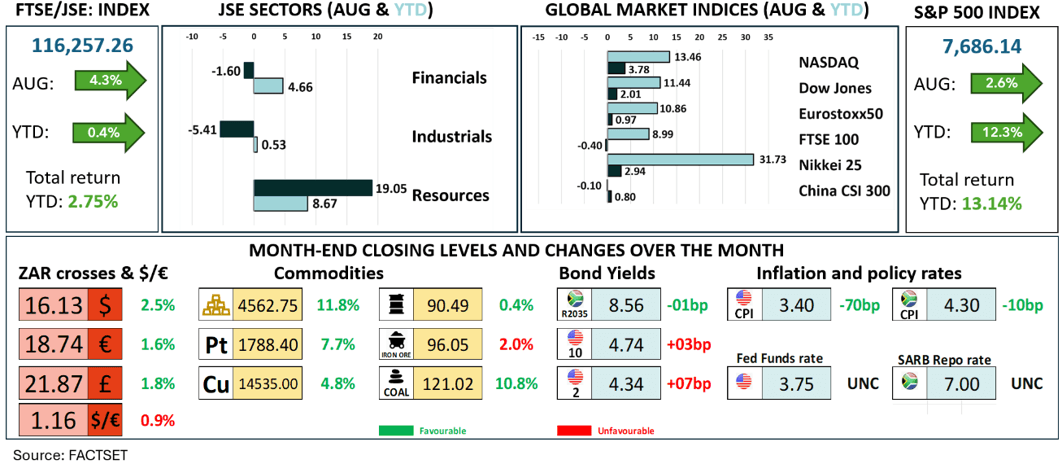
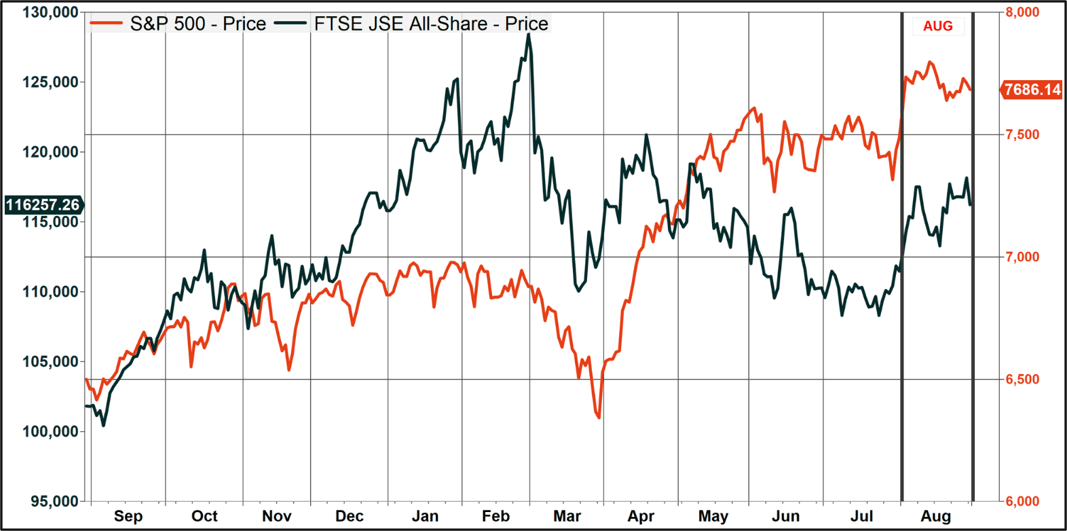
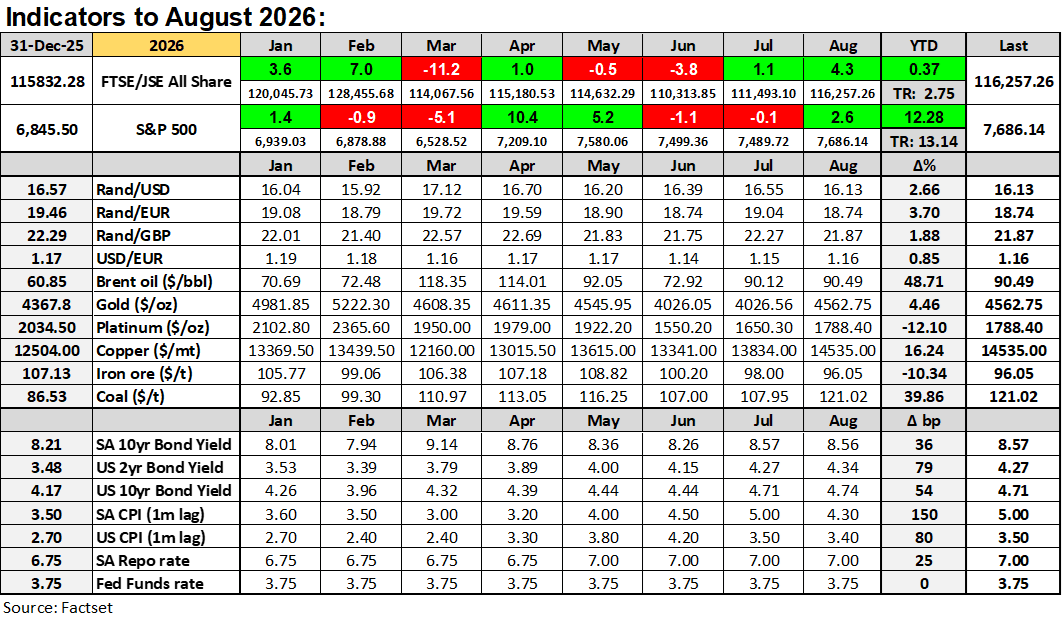
Fans of the iconic “Mad Magazine” will instantly recognise the catchphrase of the satirical magazine’s freckled mascot with the gap in his teeth, Alfred E. Neuman. Young Alfred was prone to sprouting forth his well-known phrase in dangerous situations. The equity markets seem to be doing something similar, with stock indices moving higher as global conflict continues, oil prices remain elevated and inflation and higher interest rates threaten. While markets stared down those loaded gun barrels, investors chose to focus rather on strong corporate earnings growth, the boom in artificial intelligence and some moderation in inflation. The FTSE/JSE All Share index gained 4.3% in August, its second-best month of the year, while the S&P 500 rose 2.6% for the month (see the one-year chart of the two indices below). When August was said and done, the JSE was left 0.4% up for the year and the S&P was left 12.3% higher for 2026 so far. In total return terms, with dividends added, the JSE recorded a gain of 2.75%, and the S&P 500 was up 13.14% for the first eight months of the year. The S&P 500 did record a fresh all-time high on the 13th of August at 7,757.74 index points but the JSE’s all-time high remains the closing value of 128,456 index points recorded on 27 February earlier this year.
FTSE/JSE All Share index (black, LHS) and S&P 500 (vermillion, RHS): One year (daily)
Source: Factset
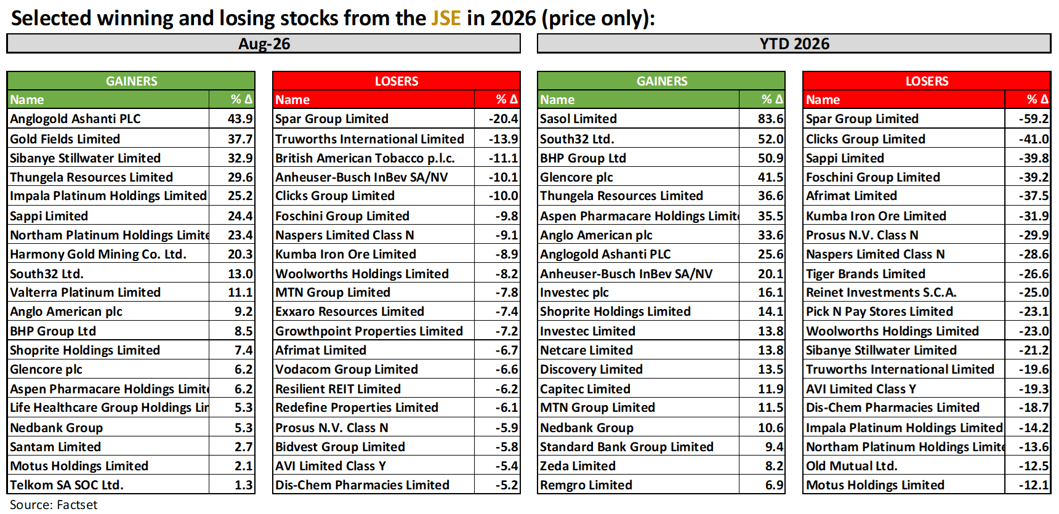
The positive move for the JSE in August lifted the index back into the green for the year-to-date but gains were not evenly distributed across the market. The almost 12% increase in the gold price and the near 8% gain in the platinum price were key catalysts responsible for the 19.1% return from the Resources sector in August. AngloGold Ashanti (+43.9%), Gold Fields (+37.7%) and Sibanye Stilwater led the way higher as the miners benefited from their operational leverage on growing commodity prices. The decline of 5.4% in the Industrials index reflected the weakness in the domestic economy (sharply lower local retailers) along with weakness in the rand-hedge consumer staples (BAT down 11% and AB InBev down 10%) and the beleaguered TenCent which dragged down Naspers (-9.1%) and Prosus (-5.9%). The Financials sector was also a detractor from overall market performance, falling 1.6% for the month, with Sanlam (-1.4%), Old Mutual (-2.4%), Investec (-2.5%), FirstRand (-3.4%), Standard Bank (-3.5%), Capitec (-1.3%) and Discovery (-1.5%) all in the red.
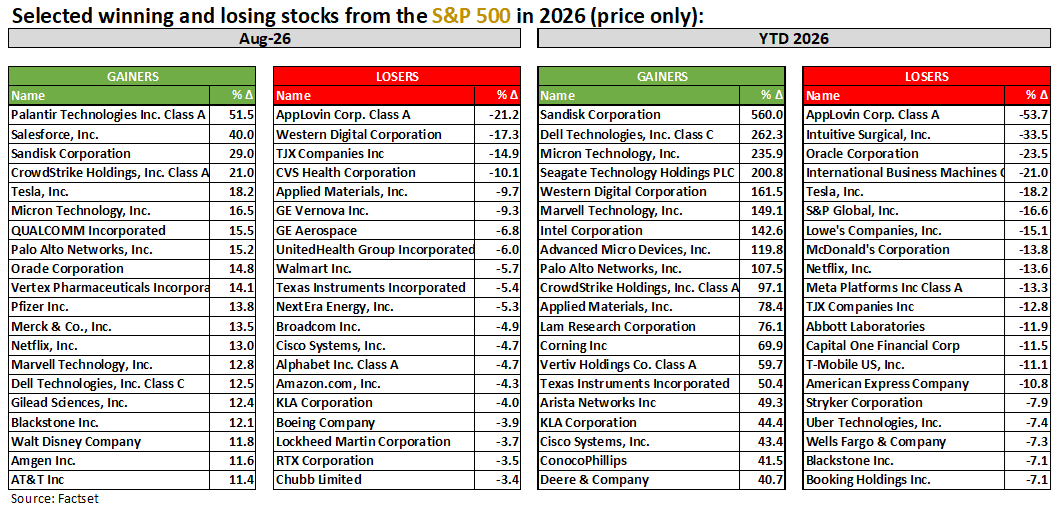
The S&P 500’s 2.6% gain in August was a reversal from the mild weakness experienced during June and July. The US second quarter earnings season slowly wound down during August with Nvidia reporting at the very end of the month. The ”Magnificent Seven”, which includes Nvidia, recorded earnings growth of 119% year-on-year for the second quarter while the remaining 493 companies reported 32% year-on-year earnings growth. The strong results from the technology and AI-relate companies were tempered somewhat by the massive capital investments being made by these companies that cast some doubt in investors’ minds as to the timing and magnitude of returns on those substantial investments. While the companies investing those vast amounts of capital are anticipating exponential returns in time and are confident in their expansion plans, many investors have balked at the size of capex and borrowings and the fact that many of these big players are turning free cash flow negative. Nevertheless, despite the weakness exhibited by a number of hyperscalers, technology was one of the leading sectors in August. A resurgence in software counters and the cybersecurity stocks played a large part in that outcome. The Energy sector was another big winner in the month as tensions in the Middle East kept the cost of energy elevated. Apart from Energy (+6.48%) and Technology (+6.19%), the two other market sectors that outperformed the 2.6% gain in the S&P 500 were Materials (+5.82%) and Healthcare (+4.78%). The underperforming sectors included Financials (+1.22%), Consumer Discretionary (-0.09%), Consumer Staples (-0.79%), Communication Services (-1.23%), Real Estate (-2.00%), Industrials (-2.69%), and Utilities (-5.18%). (See the appendix for some of the biggest individual winning and losing stocks on the JSE and the S&P 500 in August and for the year-to-date)
With technology on the front foot, the NASDAQ Composite index rose 3.8% during the month and was 13.5% higher for the year so far. The 30-stock Dow Jones Industrial Average gained 2.0% and remained 11.4% ahead for the year. Japan's Nikkei 225 delivered a further 2.9% gain during August and remained an extraordinary 31.7% higher year-to-date. In Europe, the Eurostoxx50 rose 1.0% and the FTSE 100 declined 0.4%. China's CSI 300 managed only 0.8% in August to remain effectively flat for the year, highlighting the ongoing divergence between the developed markets and China.
Inflation and monetary policy
Central bankers around the world have been sleeping with one eye open at night, with that eye firmly fixated on inflation releases. The message has been clear from the policy-makers, higher short-term interest rates are a blunt instrument against price shocks but they are the tool of choice when combatting second-round inflation effects. Despite this uniform approach, central banks have not been acting in unison. The South African Reserve Bank (“SARB”) was one of the first to hike rates, opting to act before second round effects became entrenched and inflation expectations worsened. The European Central Bank (“ECB”) and the Bank of Japan (“BoJ”) also hiked rates, with the latter continuing its drive to normalise interest rates after decades of deflation and zero interest rates. The Bank of England (“BoE”) and the Federal Reserve Bank (the “Fed”) chose to hold steady and wait for more evidence of second round inflation effects. “Open mouth operations” did not abate, however, and the rhetoric from central bankers came with a harsh tone and a warning that inflation above specified targets would not be tolerated and policy would be adjusted to return inflation to its desired levels. That was the message in the minutes of the meetings, the post-meeting press conferences and the ad hoc soundbites in the media. At the Jackson Hole Symposium in Wyoming at the end of August, the keynote address from the recently appointed Fed chair, Kevin Warsh, was the same. Warsh was firm on the inflation target of 2% and the Fed’s strong commitment to achieving the target, in large part through the use of short-term interest rates and not other unconventional means. He also committed to a disciplined policy framework with decision-making on a meeting-by-meeting basis. The new Fed chair reiterated his stance on not providing forward guidance on policy decisions and his preference for the market to do its own analysis on economic conditions and arrive at its own conclusions. That includes understanding the US Treasury’s move to ramp-up their bond-buying of longer-dated maturities and what that might mean for the US yield curve.
Consumer inflation rates have moderated in recent months post the initial inflation surge but with Brent crude still hovering around $90/barrel, inflation risks remain firmly to the upside. Warsh was adamant in his speech that underlying inflation had not meaningfully improved. Post Jackson Hole, the probability of a Fed rate hike in September increased while the probability of rate hikes from the other central banks remained high. A number of the developed economy central banks have a dual mandate to protect the value of their local currency (i.e. manage inflation) while being mindful of economic growth at the same time. For the SARB, it’s only about inflation and Governor Kganyago has often directed the fiscal authorities to provide the stimulus for growth, rather than leaving it to the monetary authorities. Nevertheless, ever-softening growth could sway thinking around demand-driven inflation and keep rates unchanged in the absence of evidence to the contrary.
It does look like the stage is set for some tightening of monetary policy around the globe as the last four months of the year play out. The big four developed economy central banks have three more meetings this year while the SARB has only two remaining meetings. The Fed (16 Sep), ECB (10 Sep), BoE (17 Sep) and BoJ (18 Sep) all pronounce on policy this month, with the SARB (23 Sep) set to meet towards the end of the month. Each economy is unique and policy in each is nuanced, which leads to different probabilities of rates being hiked at the September meetings. With the big four central banks holding their following meetings during late October and early November, there is an opportunity for another month of “wait and see”, along with a December meeting backstop. The SARB’s final meeting of 2026 is on 19 November so there’s also an opportunity to adjust policy fairly soon if inflation does not continue to moderate and rates are kept on hold in September. Voting on policy actions was not unanimous at the July meetings (SARB 4:2, Fed 9:3, BoE 6:3, BoJ 9:1) and while the majorities voted for unchanged rates, a change of heart from a few individuals can swing the next decision, as can an errant inflation print. The biggest determinant of the Fed’s September meeting outcome will be the August CPI print the week before the meeting. With the BoJ set on normalising rates over the longer-term, that bigger picture thinking could make a rate hike from the BoJ in September the one with the highest probability. Forecasts on the ECB’s September meeting, however, are flip-flopping between no change and a final hike in the cycle.
The wall of worry remains
The US third quarter earnings reporting season will only kick-off in mid-October but expectations for earnings growth are high and should continue to support market valuations. In the US and elsewhere, investment into AI continues to be a strong driver of growth even though the massive demand for components is bringing an additional element of inflation. With no end in sight to the Middle East conflict, the foundations of the wall of worry remain and those include high energy prices, high inflation, high interest rates and high valuations (with high investor expectations). A disappointment on any of those fronts could see the market slip down the wall. But the earnings grappling hook is made of sterner stuff and peace in the Middle East could just add some extra grip to those wall of worry climbing boots.
Appendix:
Selected central bank meeting dates for the remainder of 2026
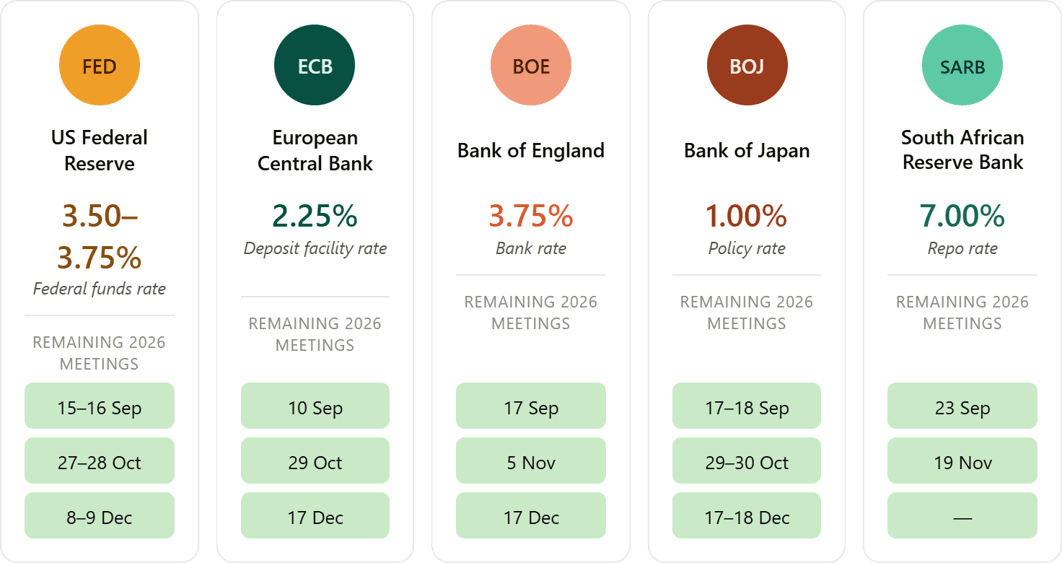
Source: Central Banks' Websites

Craig Pheiffer