
The June memorandum of understanding that brought peace to the US-Iran conflict was very short-lived and July was marked by continuous strikes and counterstrikes between the warring parties.
Missiles, markets and monetary policy
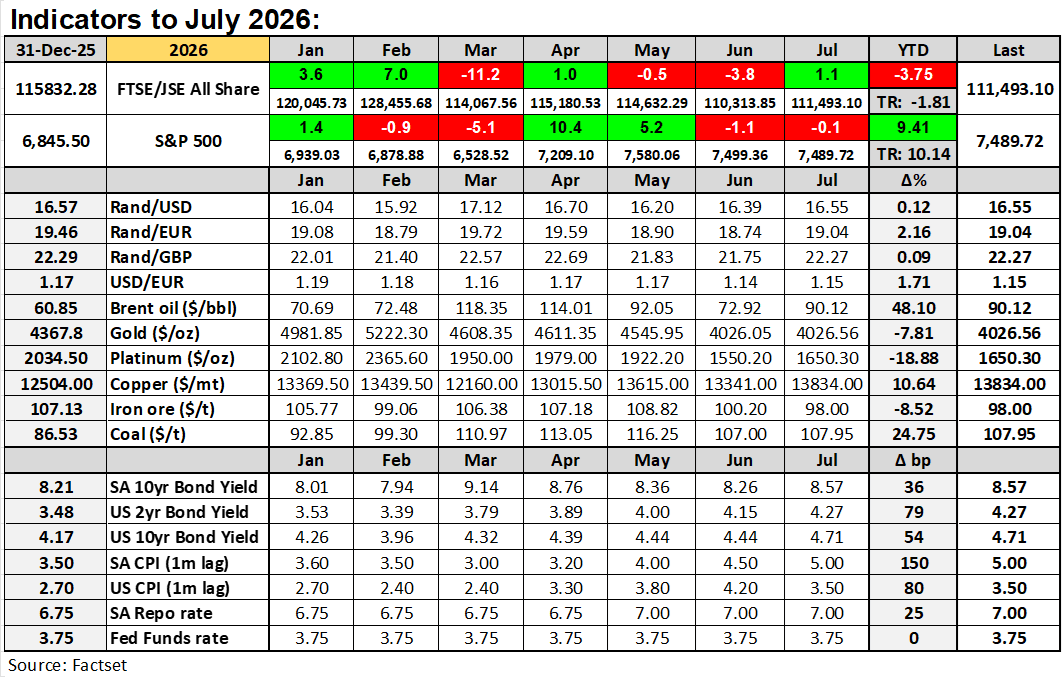
The June memorandum of understanding that brought peace to the US-Iran conflict was very short-lived and July was marked by continuous strikes and counterstrikes between the warring parties. Oil prices returned to the nineties as the Strait of Hormuz closure renewed concerns around oil supply. Geopolitical risks remained elevated throughout the month and while US bond yields moved higher, equity markets shrugged off the conflict, believing (or hoping) that a longer-lasting peace would eventually result. The Federal Reserve Bank’s Open Market Committee met for the second time under Kevin Warsh’s leadership and opted to keep policy rates unchanged at the 3.75% level, where they started the year. The committee was not unanimous in their decision and three dissenters at the meeting preferred rates to be hiked by 25 basis points. Rising bond yields over the month pointed to growing expectations that rates will be raised at the Fed’s next meeting in September. Since taking the chair, Warsh has been adamant on two points. The first point is that the inflation target is 2% and the Fed will act to achieve price stability at that level and not anything higher. The second point is that there will be no forward guidance on policy. The Fed will adjust policy on the data to hand at each meeting and will not guide to any future level of interest rates. The jury is out on whether rates will be raised in the short-term but expectations are growing that any increase in rates will simply be a bump in the road, with policy easing resumed at some point in 2027.
The artificial intelligence theme continued to dominate the markets in July, against the backdrop of second quarter earnings reporting season. Investors continued to question the magnitude of capital expenditure by the hyperscalers and the extent to which that expenditure is being monetised. Evidence of growing returns from that capex is there but the investment numbers keep growing and eating substantially into free cash flows. Alphabet, Amazon and Oracle reported negative free cash flows after their massive capital expenditure while Meta’s was left marginally in the black. The memory chip makers had a very unhappy month overall, with market darling SK Hynix losing 35% in July (down 41% from its 25 June peak) and Samsung losing 21% in the month (down 27% from its 25 June peak). These South Korean stocks contributed to the Kospi index’s largest reversal on record as excessively leveraged retail investors found themselves being called for margin in a collapsing market, where trading halts had to be put in place. On the very last day of July the Kospi jumped 18% to record its largest single day rise in its history, as SK Hynix and Samsung bounced 30% and 27% respectively. Despite the last day hoorah, the shares remained substantially below the peaks that they had reached in late June.
US second quarter earnings season kicked off during the second week of July and the S&P 500 reporting was just over 60% done by the end of the month. The earnings were very supportive of the market, with 86% of companies beating market expectations and aggregate earnings per share printing more than 31% ahead of expectations. Mergers and acquisitions continued strongly in the month and the biggest recent corporate event was the listing on 12 June on the NASDAQ of SpaceX. At the initial public offering (“IPO”) price of $135 the company raised $86bn for a market capitalisation of $1.77 trillion. The stock jumped to over $200 a share after trading began (intra-day peak of $219 on 16 June) to leave the company with a $2.1 trillion market capitalisation and Elon Musk with the title of trillionaire. The SpaceX IPO hype, which sucked investor capital from AI stock winners, didn’t last long and the share halved in price before the end of July. Musk was left with a net worth closer to $700bn at month-end but remained the wealthiest person in the world by a large margin. Some IPO investors will have their first opportunity to sell their shares in early August while others will have to wait for the share to recover to its $135 listing price before they’re freed from lockup. SpaceX closed out July at a price of $108.37 per share and investors will be watching for any further fallout from the additional shares that could potentially come to the market.
FTSE/JSE All Share index (black, LHS) and S&P 500 (vermillion, RHS): One year (daily)
%20and%20S%26P%20500%20(vermillion%2C%20RHS)%20One%20year%20(daily).png?v=2026-08-13T08%3A17%3A52.205Z)
Source: FACTSET
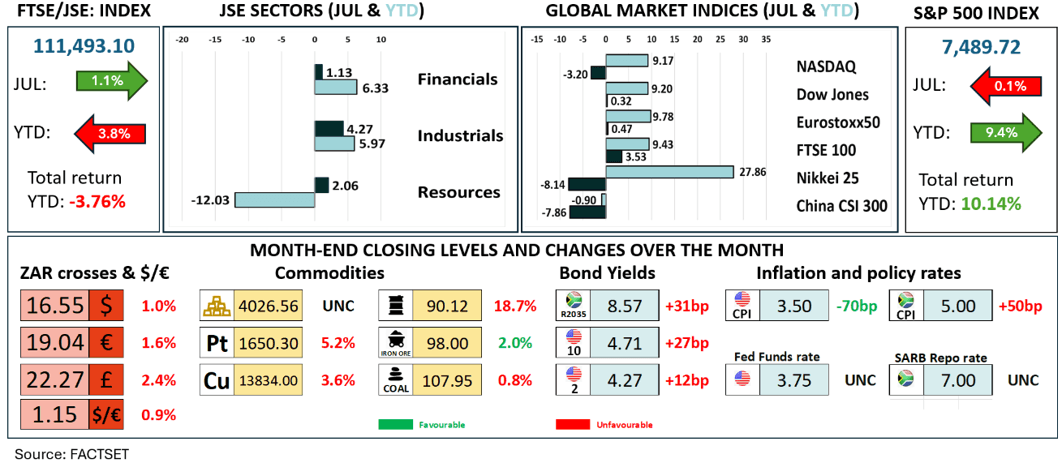
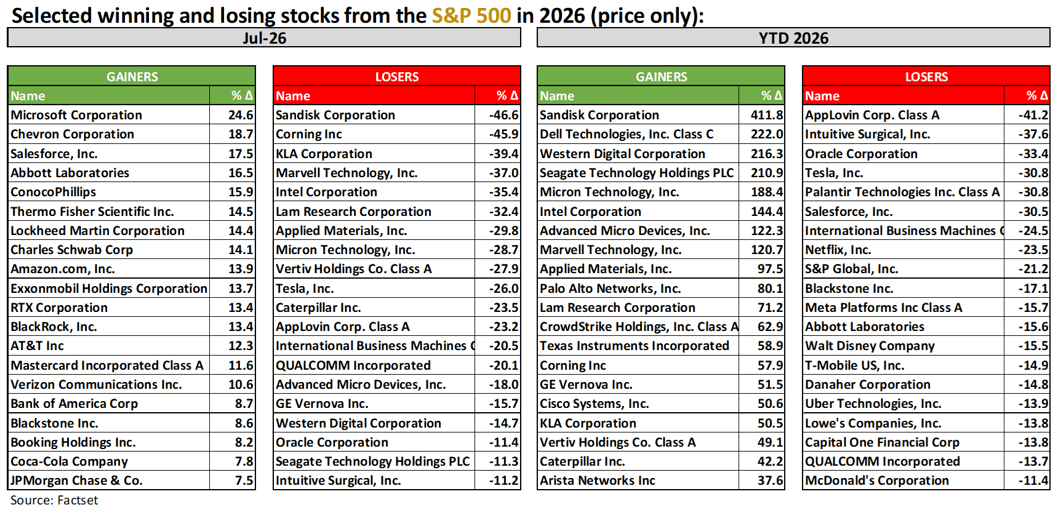
The S&P 500 declined by 0.1% in July after falling 1.1% in June (see the chart above). The equal-weighted S&P 500, however, rose by 1.1% to reflect a broader, more positive market sentiment. Despite four of the seven months of 2026 being negative, the S&P 500 cap-weighted index remained 9.4% higher for the year-to-date (a total return of 10.1%). Information technology stocks were the biggest detractors from the S&P 500’s performance in July and the 25% gain in Microsoft was not enough to overcome the broader weakness in the technology sector (see the list of winners and losers in the appendix below). The sectors that outperformed the S&P 500’s 0.1% decline included Energy (+12.5%), Financials (+6.0%), Real Estate (+2.5%), Healthcare (+2.2%), Consumer Staples (+1.9%), Consumer Discretionary (+0.8%) and Communication Services (+0.5%). The underperforming sectors included Materials (-1.7%), Utilities (-2.3%), Industrials (-3.1%) and then Information Technology (-3.5%).
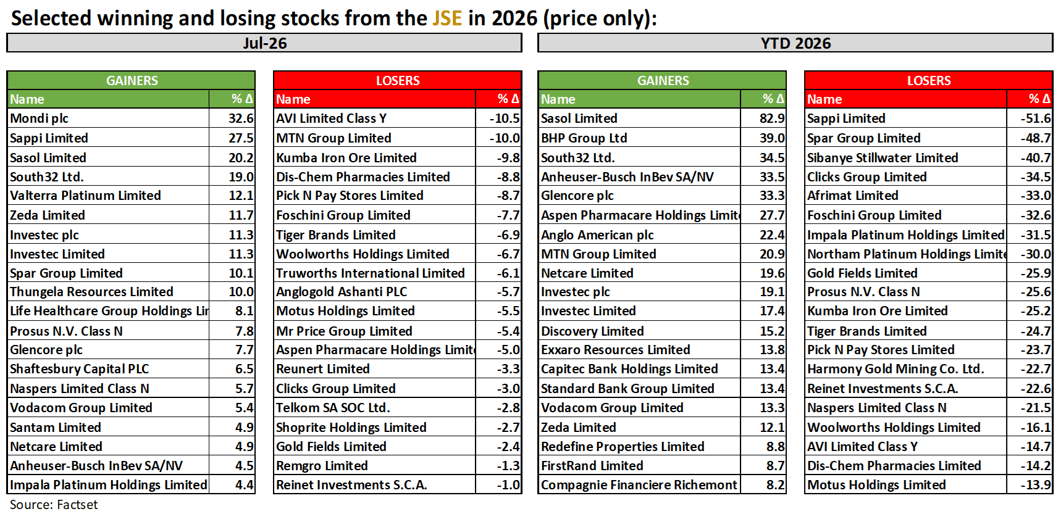
The JSE finished in the green in July after posting negative returns in the previous two months. The 1.1% gain in the FTSE/JSE All Share index left the market down 3.8% for the year-to-date with a total return of -1.8% (including dividends). All three market segments were up, with Industrials gaining 4.3%, Resources gaining 2.1% and Financials gaining 1.1%. Amongst Industrials, the two paper stocks led the way higher in July with Mondi up 33% and Sappi up 28%. Despite the strong month, Sappi still topped the biggest losers list for the year-to-date with a decline of 52% (Mondi was left at -2.7% YTD). The list of stocks with a negative return in July were filled with the names of local retailers, food-producers and consumer-facing companies: AVI (-11%), Dis-Chem (-9%), Pick n Pay (-9%), Foschini (-8%), Tiger Brands (-8%), Woolworths (-7%), Truworths (-6%), Mr Price (-5%), Clicks (-3%) and Shoprite (-3%). The gold price was flat over the month and platinum was up 6% and that helped South32 (+19%), Valterra Platinum (+12%) and Impala Platinum (+4.4%) to make the winners list in July. Energy stocks Sasol (+20%) and Thungela Resources (+10%) were also in the green, being boosted by higher energy prices.
War and Peace, Bull and Bear
The way forward for markets will continue to be dictated by developments on the geopolitical front. More war and a protracted period of high oil prices will force the hand of central banks as headline inflation drifts further away from target. Higher interest rates will hurt equity markets, bond yields will remain elevated and ultimately, economic growth will slow and negatively impact corporate earnings. A lasting peace deal, however, will get oil and gas flowing, energy prices will fall (or stabilise at lower levels), inflationary forces will weaken and the pressure on central banks to hike rates will dissipate and may, in time, see the monetary-easing cycle resume. Lower rates will encourage demand and deal-making and the equity market will benefit, particularly with corporate earnings supported. Bond-holders will benefit from modest capital gains on top of their fixed interest in a falling interest rate environment. The market outcome may not be purely binary, however, and while we wait for a clear steer on the war, we could still muddle along for a time with daily shifts between market optimism and pessimism. With local valuations on the cheaper side and US earnings growth on the stronger side, there’s still good reason for optimism to be the dominant sentiment.
Appendix:

Craig Pheiffer

The interest-rate story South Africans should really be watching
Interest-rate decisions are often explained through numbers: repo rate, prime rate, basis points and inflation forecasts. But for ordinary South Africans, the real story is more personal. It is about confidence; choices and the daily trade-offs households make when money becomes more expensive.
Read more