Monthly economic and market review: May 2026

Monthly insights into global markets, earnings, and economic developments shaping investment conditions.
The darling markets of May
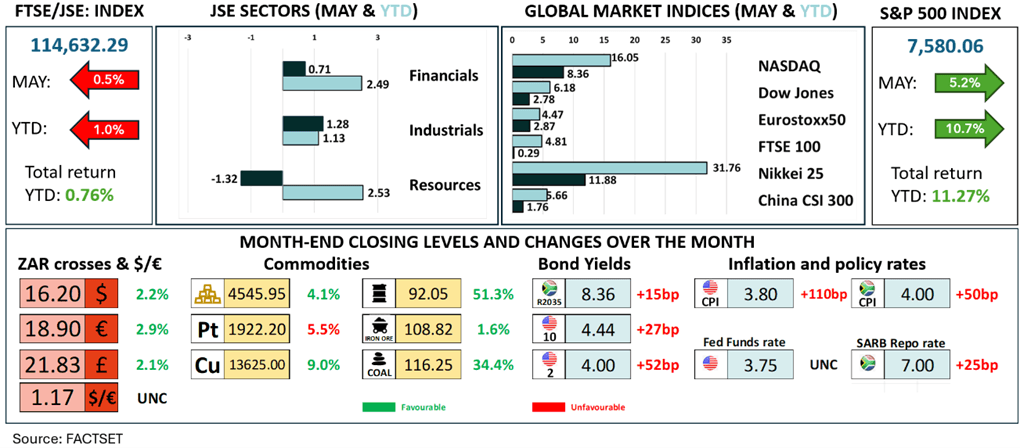
The Dow, the NASDAQ and the S&P 500 all closed out May at record levels as markets anticipated a memorandum of understanding between the US and Iran that was expected to lead to a two-month ceasefire, allowing more time to negotiate the finer details of a longer-term peace deal.
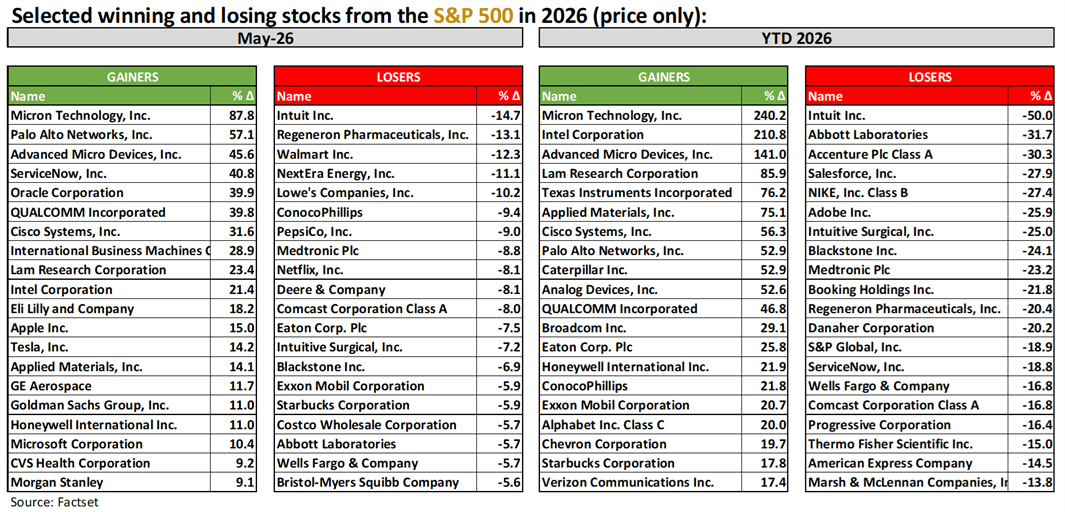
Against the backdrop of a more “risk-on” environment, markets were boosted by the continued strength in memory and semiconductor stocks as the Artificial Intelligence (“AI”) theme continued to dominate investor thinking. Demand for compute has seen the massive capital expenditure from the hyperscalers continue and virtually all players in the AI production and supply chain have benefitted. Software stocks staged a mini recovery in the month, after having been brutally beaten down on expectations that AI would eat their lunch. Palo Alto (+57%) and ServiceNow (+41%) were two notable software gainers in the month. Memory-producing companies were the real standout, however, and Micron’s 88% gain in May lifted the counter to a 240% gain for the year so far. The NASDAQ Composite index, home to many big technology names, grew 8.4% in May to be left up 16.1% for the first five months of 2026.
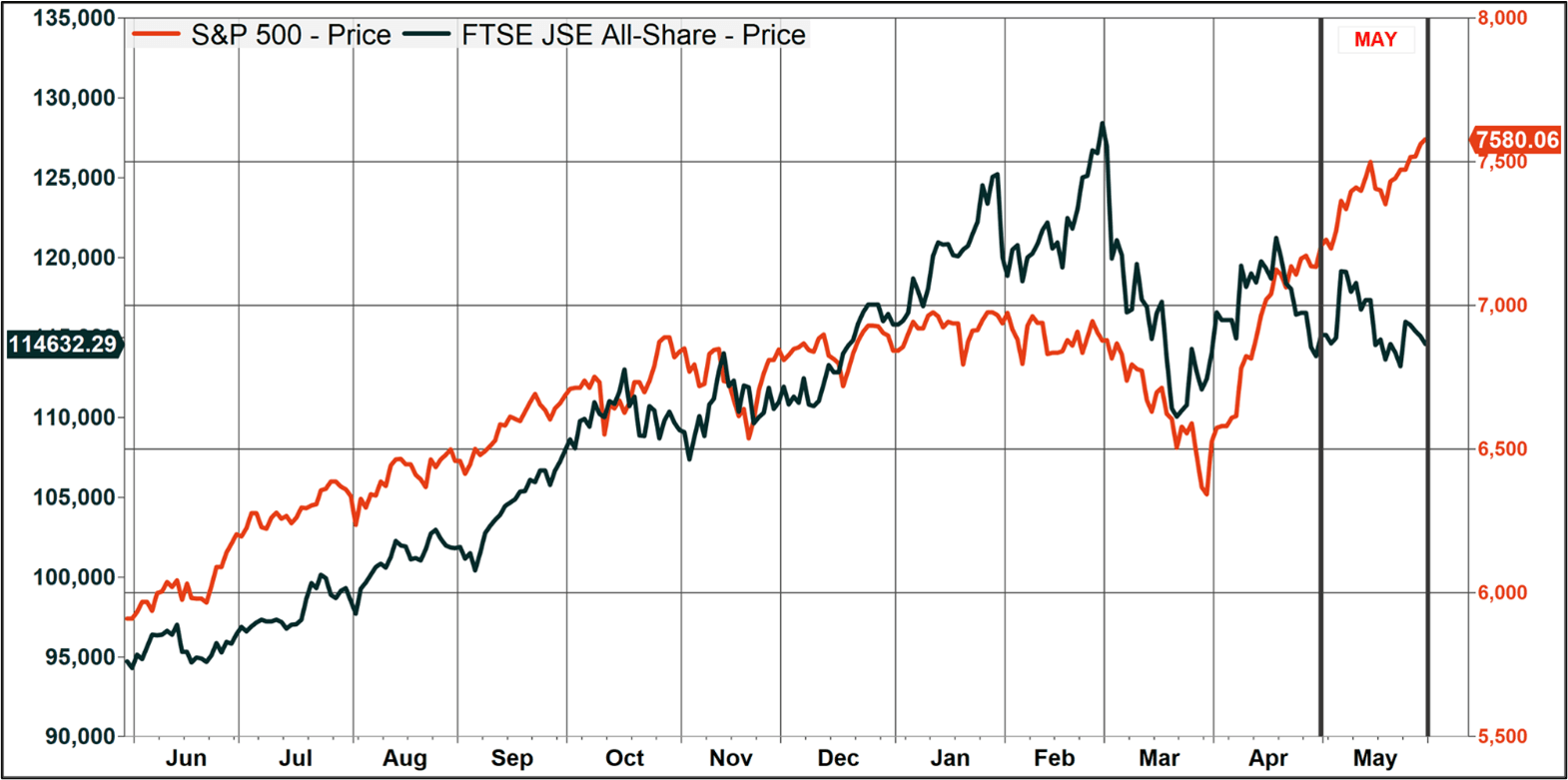
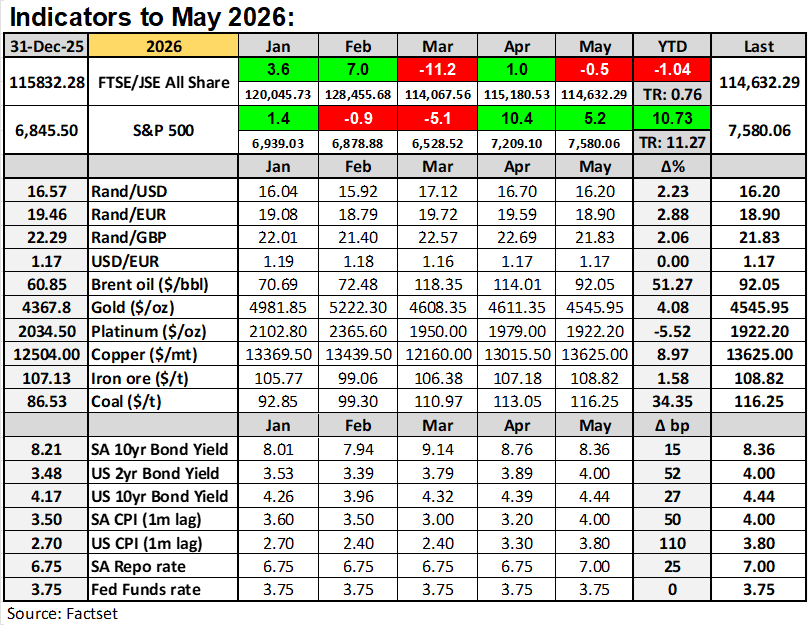
While technology stocks were the big winners in May, the energy sector was the biggest loser, as relative peace prevailed during the month and energy prices retreated moderately. The S&P 500 index gained 5.2% in May to follow the 10.4% gain of April, with the Technology sector (+15.9%) the only sector to outperform the index in May. Energy (-6.1%) was the biggest underperformer, followed by Utilities (-5.5%), Consumer Staples, (-3.3%), Financials (-1.2%), Real Estate (-1.2%), Industrials (-1.0%), Communication Services (-0.9%), Materials (-0.9%), Healthcare (+2.31%) and Consumer Discretionary (+2.6%). Following May’s strong gain, the S&P 500 index was left 10.7% higher for the year with a total return of 11.27% (see the daily chart of the S&P 500 and the FTSE/JSE All Share index over the past year below).
The higher energy prices that resulted from the war and the closure of the Strait of Hormuz, were felt firstly in producer price inflation numbers and then in the April consumer price inflation data that was reported in May. The Federal Reserve Bank’s Open Market Committee chose to sit on their hands at their April meeting, opting to wait for additional evidence of second-round inflation effects. That meeting, which had the most dissenting votes since October 1992, was Jerome Powell’s last hurrah and the meeting set for mid-June will be the first under the leadership of Kevin Warsh. Warsh is firmly against forward guidance on monetary policy and so the quarterly Summary of Economic Projections or “dot plot” (which would be due in June) may now be assigned to the annals of history.
The South African Reserve Bank on the other hand, chose to get ahead of the inflation curve, with evidence of second-round inflation effects already taking hold. The policy rate was hiked by 25 basis points to 7.00% at their May meeting and that helped the rand and bond market yields to close the month out on a firmer footing. Over the course of May, the rand improved by 50c against the US dollar (to R16.20/$), with 10-year bond yields declining by 40 basis points. After the first five months of the year, the rand had gained between 2% and 3% against the developed market currencies while the10-year bond yield was up by only 15 basis points from its 2025 year-end level. Gold (-$66/oz) and platinum (-$57/oz) were moderately cheaper in May while copper and the bulk commodities were marginally firmer. The net effect of the stronger currency and slightly lower precious metals prices was a decline of 1.3% in the JSE’s Resources Index. Financials managed a 0.7% gain with Industrials gaining 1.3% and all of that leaving the benchmark FTSE/JSE All Share index down 0.5% for the month. For the first five months of the year, the index shrank by 1.0% but with dividends included, the total return from the local market was marginally positive at 0.76%.
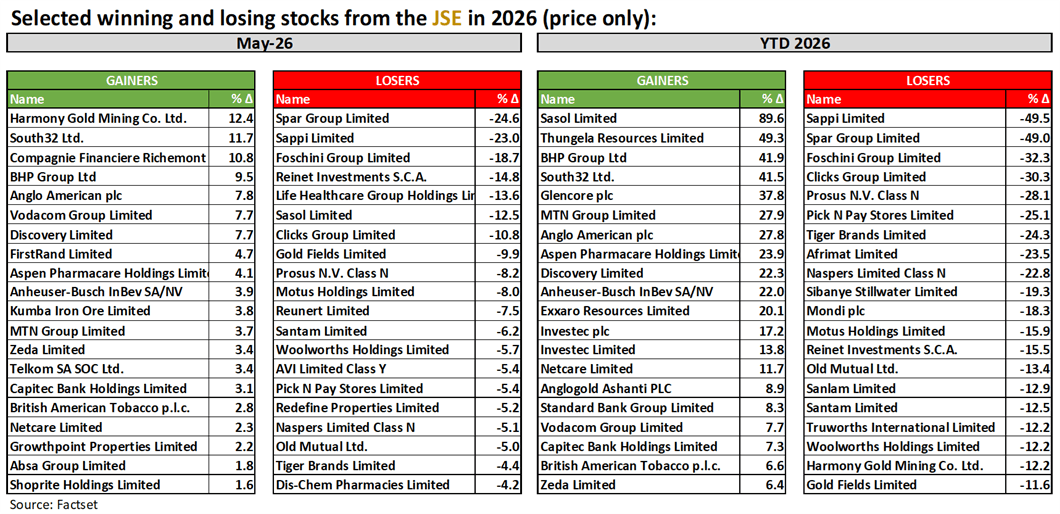
There weren’t too many positive standout individual performances during May, with Harmony (+12.4%), South32 (+11.7%) and Richemont (+10.8%), the only stocks from the Top 40 index recording double digit gains. Spar (-24.6%), Sappi (-23.0%), Foschini (-18.7%), Reinet (-14.8%) and Life Healthcare (-13.6%) were among the biggest losers in the month after communicating poor results or trading updates to the market. Resources and energy-related stocks continued to be the JSE’s best performers this year while Sappi, Naspers, Prosus and the beleaguered local retailers weighed heaviest on the market (see the list of top gainers and losers on the JSE and the S&P 500 below).
FTSE/JSE All Share index (black, LHS) and S&P 500 (vermillion, RHS): One year (daily)
Getting what you pay for
The forward price/earnings multiple of the S&P 500 currently stands at 21.8x which is almost exactly one standard deviation above the 10-year mean of 18.9x (and not that far above the five-year mean of 19.9x). Those valuations are on the higher side of the averages but can’t be considered overly expensive, particularly when one looks at the growth in the market’s earnings. The US first quarter earnings reporting season is within a hair’s breadth of being concluded and the numbers have been stellar. The Information Technology sector did report exceptional earnings growth of 54% y/y for the quarter but the good news was fairly broadly spread. A total of 85% of the S&P 500 companies reported earnings ahead of market expectations. There may be an element of “guidance management” by corporates in order to positively surprise markets but the percentage of earnings beats this quarter was the highest since the second quarter of 2021. Earnings growth for the first quarter of 2026 was 28.6% y/y which in turn was the highest growth rate since the fourth quarter of 2021. Looking to the next three quarters, analysts are projecting earnings growth of 21.6%, 24.8% and 22.3% respectively. For the 2026 calendar year, the expectation is for 22.6% earnings growth and when crudely considered against the forward price/earnings ratio of 21.8x, the market is on a sound footing, even at an index level of 7,600. It is true that the Magnificent Seven stocks grew earnings in the first quarter by 63% y/y but the other 493 counters grew earnings at a not-too-shabby pace of 17% y/y.
The market has myriad moving parts and while earnings growth is just one of them, it is a critical part. The market should continue to be underpinned by solid earnings growth but it doesn’t operate within a vacuum. The US – Iran war is on a nervous hold and tankers and freighters remain immobilised in the Strait of Hormuz. Energy prices are below recent peaks but still elevated and higher inflation is threatening more restrictive monetary policy that would tighten purse strings and reduce investment. The Federal Reserve has a new sheriff in town and the leader of the free world is focussed on morphing the Whitehouse into an entertainment palace. There are enough risks to satisfy the glass-half-empty market observers but for those seeing the glass half-filled, there is the prospect of a peaceful solution in the Middle East, lower energy prices, deflation, declining interest rates, falling bond yields and firmer equity markets. For now, we prefer to view the markets through a roseate prism.
Appendix:

Market and Economic Commentary: January 2026
The party plates from the New Year’s Eve party were hardly washed and packed away when the level of geopolitical craziness in the world was ratcheted up a notch.
Read more