Why protecting capital matters more than chasing spectacular returns across volatile markets.
There is a moment every investor eventually meets, usually alone, usually at night. The portfolio has fallen and the mind begins its quiet negotiation: it will come back. What was lost will be regained. The market gives and takes in equal measure, and patience will square the ledger.
The arithmetic, unfortunately, has not agreed to these terms.
Consider a small parable. You begin with R100. In the first year, fortune leans towards you: a return of 50%. Your R100 becomes R150, and for a season you walk a little taller. In the second year, fortune leans away: minus 50%. Your R150 becomes R75.
One good year. One bad year. Equal in size, opposite in direction. The intuition insists you should be standing where you started. Instead, a quarter of your capital has quietly left the room.
Here is the detail worth sitting with: reverse the order and nothing changes. Take the loss first and the gain second, and you still arrive at R75. Compounding is multiplication, and multiplication does not remember which came first. The damage was never in the sequence. The damage lives inside the pair itself- in the marriage of the gain and the loss, which the average so cheerfully conceals.
Because the average does conceal it. Ask a spreadsheet for the average of plus 50 and minus 50 and it will answer, truthfully and uselessly: zero. Yet the money shrank by more than 13% a year. There is a name for this gap between the return you report and the return you receive- volatility drag - and it grows with every swing of the pendulum. Two investors may tell the same story of average returns over a decade and arrive at very different destinations, because one of them travelled a smoother road. In compounding, it is not the average that pays you. It is the sequence of survivals.
The unequal weight of loss
Beneath the parable sits an older truth, one the market never announces but always enforces: losses and gains do not weigh the same.
Lose 10%, and an 11% gain restores you. Lose a quarter, and you need a third. Lose half, and you need a double - a 100% return, merely to stand again where you once stood. Lose 90%, and you need the kind of tenfold ascent that arrives perhaps once in an investing lifetime, and usually to someone else.
The hole deepens faster than the ladder lengthens. The road down and the road back are not the same road; the descent is swift and the return is long, and the minus sign knows this even when we do not.
This is why the investors who survive speak so plainly about it. Warren Buffett's first rule is not to find the greatest winner but never to lose money. Seth Klarman built a career on the margin of safety - the space you leave between price and value for the day you are wrong, because there will be such a day. Howard Marks observed that if you simply avoid the losers, the winners will take care of themselves. None of this is modesty. It is arithmetic wearing the clothes of wisdom.
The long game is a chain
We are drawn, all of us, to the spectacular year. The tripling stock, the perfectly timed entry, the story told at the braai. But compounding is not a collection of years; it is a chain, and a chain does not average its links. It breaks at the weakest one.
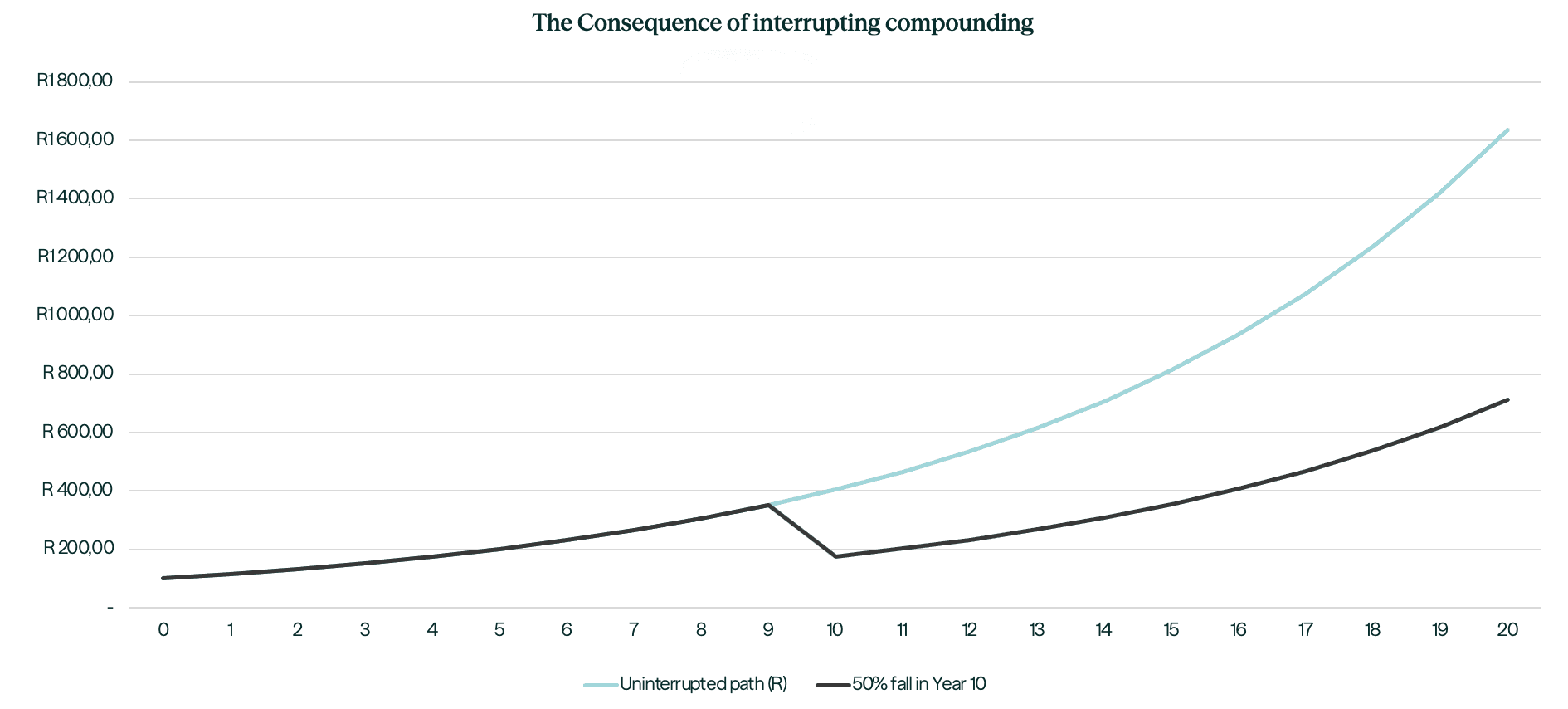
A portfolio compounding at 15% for twenty years multiplies its owner's capital more than sixteen times. Interrupt that journey once - a single blow-up, a 50% wound never fully healed - and the destination is not dented but transformed. The catastrophe does not cost you the year in which it happens. It costs you every year that was meant to be built upon it. The blow-up steals from the future, and the future cannot file a complaint.
So the discipline reveals itself, slowly, as something almost spiritual: the willingness to want less to end with more. To own the durable business rather than the dazzling one. To leave the margin. To decline the wager that could end the game, however seductive its odds. Defence, in compounding, is not the opposite of ambition. It is ambition that has learned to count.
The market will always offer you the chance to reach for the spectacular. The arithmetic asks a quieter question, and it asks it every day: can you remain at the table long enough for time to do its work?
The investor who respects the minus sign - who understands what it takes, and how slowly it gives back -has already answered.

Andrew Padoa

Your future starts with what you save today
Time matters because money needs time to grow. The earlier you begin, the longer your savings have the opportunity to benefit from compound growth, where returns can begin earning returns of their own.
Read more